Government salary deductions in the Philippines consist of four mandatory items taken from your pay every month: withholding tax, SSS, PhilHealth, and Pag-IBIG. Together, these typically account for 10% to 20% of your gross salary, depending on how much you earn.
This guide brings together everything from our deduction series in one place. You’ll see how each deduction is computed, how they interact with each other, and a full sample computation showing exactly how a gross salary becomes your final take-home pay.
- The Four Government Salary Deductions at a Glance
- Withholding Tax
- SSS Contribution
- PhilHealth Contribution
- Pag-IBIG Contribution
- Free Calculators for Each Deduction
- How These Deductions Interact With Each Other
- Full Example: From Gross Salary to Take-Home Pay
- Side-by-Side Comparison Table
- Why Your Payslip Looks Different From a Coworker's
- Frequently Asked Questions
- Final Thoughts
The Four Government Salary Deductions at a Glance
Every formally employed worker in the Philippines has these four items deducted from their gross salary, in this order, before arriving at take-home pay:
| Deduction | Purpose | 2026 Rate |
|---|---|---|
| Withholding Tax | Income tax, remitted to the BIR | 0% to 35%, bracketed |
| SSS | Social insurance and pension | 5% of MSC (you), 10% (employer) |
| PhilHealth | National health insurance | 2.5% of salary (you), 2.5% (employer) |
| Pag-IBIG | Housing fund and forced savings | 1-2% of salary (you), 2% (employer) |
Withholding Tax
Withholding tax is your income tax, collected gradually every payday instead of as one annual lump sum. It’s computed on your taxable compensation, which is your gross pay minus your SSS, PhilHealth, and Pag-IBIG contributions. Under the TRAIN Law, anyone earning ₱20,833 or less a month pays no withholding tax at all, while higher earners fall into brackets ranging from 15% to 35% on the portion of income within each bracket.
For the full 2026 BIR tax table, step-by-step computation, and 13th month pay rules, read our complete Withholding Tax guide.
SSS Contribution
Your SSS contribution funds sickness, maternity, disability, unemployment, and retirement benefits. Instead of using your exact salary, SSS maps your pay to a Monthly Salary Credit (MSC) bracket, ranging from ₱5,000 to ₱35,000, then applies a 15% total rate split 5% employee and 10% employer.
There’s an important nuance here: while your contribution is based on MSC up to ₱35,000, most short-term benefits are computed using a separate ₱20,000 cap, with the excess routed into your Mandatory Provident Fund. Our SSS Contribution guide and Monthly Salary Credit explainer cover this in full.
PhilHealth Contribution
PhilHealth funds your national health insurance coverage, including hospital confinements, selected outpatient procedures, and coverage for your qualified dependents. The rate is a straightforward 5% of your monthly salary, split evenly at 2.5% each between you and your employer, within a ₱10,000 floor and ₱100,000 ceiling.
See our full PhilHealth Contribution guide for sample computations and what your coverage includes.
Pag-IBIG Contribution
Pag-IBIG is your smallest mandatory deduction, but functions more like a forced savings account than insurance. You contribute 1% to 2% of your salary depending on your income level, capped at a ₱10,000 Maximum Fund Salary, meaning your contribution never exceeds ₱200 a month. This builds toward your Total Accumulated Value, which you can eventually withdraw, plus gives you access to Pag-IBIG housing and salary loans.
Read the full breakdown in our Pag-IBIG Contribution guide.
Free Calculators for Each Deduction
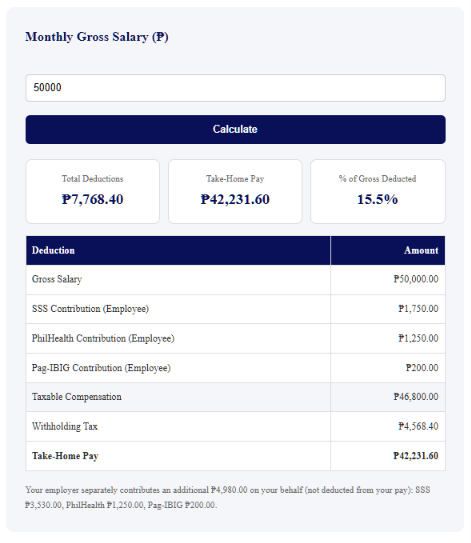
Rather than computing each deduction by hand, use our dedicated calculator below to get your exact figures:
- Withholding Tax Calculator
- SSS Contribution Calculator
- PhilHealth Contribution Calculator
- Pag-IBIG Contribution Calculator
- Complete Salary Deduction Calculator
How These Deductions Interact With Each Other
These four deductions aren’t computed independently. In simple terms, three of them come out first, and the fourth is computed on what’s left over. Here’s the actual order:
- SSS, PhilHealth, and Pag-IBIG are deducted first, based on your gross salary.
- What remains becomes your taxable compensation. Your withholding tax is computed on this reduced figure, not your full gross salary.
- Withholding tax is deducted last, giving you your final take-home pay.
This is why increasing your SSS, PhilHealth, or Pag-IBIG contributions, whether through a salary increase or voluntary top-up, indirectly lowers your income tax as well, since it shrinks the base your withholding tax is calculated on.
Full Example: From Gross Salary to Take-Home Pay
Let’s say you earn ₱30,000 a month. Here’s exactly how each deduction is computed, in order:
| Step | Computation | Amount |
|---|---|---|
| Gross Salary | – | ₱30,000.00 |
| Less: SSS (MSC ₱30,000 × 5%) | Employee share | -₱1,500.00 |
| Less: PhilHealth (₱30,000 × 2.5%) | Employee share | -₱750.00 |
| Less: Pag-IBIG (capped at ₱10,000 × 2%) | Employee share | -₱200.00 |
| Taxable Compensation | ₱30,000 – ₱2,450 | ₱27,550.00 |
| Less: Withholding Tax | 15% over ₱20,833 | -₱1,007.55 |
| Take-Home Pay | – | ₱26,542.45 |
From a ₱30,000 gross salary, total government deductions come out to ₱3,457.55, about 11.5% of gross pay, leaving a take-home pay of ₱26,542.45.
Side-by-Side Comparison Table
| Monthly Salary | SSS | PhilHealth | Pag-IBIG | Withholding Tax | Take-Home Pay |
|---|---|---|---|---|---|
| ₱15,000 | ₱750.00 | ₱375.00 | ₱200.00 | ₱0.00 | ₱13,675.00 |
| ₱25,000 | ₱1,250.00 | ₱625.00 | ₱200.00 | ₱440.63 | ₱22,484.37 |
| ₱40,000 | ₱1,750.00 | ₱1,000.00 | ₱200.00 | ₱2,850.05 | ₱34,199.95 |
| ₱60,000 | ₱1,750.00 | ₱1,500.00 | ₱200.00 | ₱7,679.55 | ₱48,870.45 |
Notice that SSS and Pag-IBIG flatten out at higher salaries due to their caps, while PhilHealth and withholding tax continue scaling up. This is why, as your salary grows, withholding tax becomes an increasingly larger share of your total government deductions.
Why Your Payslip Looks Different From a Coworker’s
- Different pay frequency. Monthly-paid and semi-monthly-paid employees use different withholding tax tables, so a direct payslip comparison can look off even at the same salary.
- Different MSC or salary bracket boundaries. Two coworkers earning ₱100 apart can land on different SSS or Pag-IBIG brackets, creating a small but real difference in deductions.
- De minimis benefits and allowances. Non-taxable perks like rice subsidies or uniform allowances reduce taxable compensation differently depending on what your employer offers.
- Year-end annualization. December payslips often look different from the rest of the year due to true-up adjustments on withholding tax.
Frequently Asked Questions
What percentage of my salary goes to government deductions?
It depends on your salary level, but typically 10% to 20% of gross pay for most employees, with higher earners paying a larger share due to withholding tax scaling up with income while SSS and Pag-IBIG are capped.
Which deduction is computed first?
SSS, PhilHealth, and Pag-IBIG are deducted first, based on your gross salary. Withholding tax is computed last, based on what remains after those three deductions.
Are all four deductions mandatory?
Yes, for formally employed workers in the Philippines. Withholding tax, SSS, PhilHealth, and Pag-IBIG are all required by law, though withholding tax may be zero if your income falls below the taxable threshold.
Do these deductions increase every year?
Not always. For 2026, all four rates remain unchanged from 2025, since SSS, PhilHealth, and the TRAIN Law tax brackets have each reached their final scheduled rates, and Pag-IBIG’s current schedule has been in place since February 2024.
Which deduction gives me something back directly?
Pag-IBIG functions closest to a personal savings account, with your contributions and dividends accumulating under your name for eventual withdrawal. SSS and PhilHealth function more like insurance, paying out specific benefits when you qualify, such as sickness, maternity, or hospitalization.
Final Thoughts
Your payslip’s deduction section can look intimidating, but each line has a clear, computable logic behind it, and none of them are arbitrary. Understanding how withholding tax, SSS, PhilHealth, and Pag-IBIG interact also helps you plan around raises, bonuses, and even voluntary contributions, since a change in one deduction often ripples into another.
For a deeper look at any single deduction, explore the full guides linked throughout this article, or jump straight to the calculators to check your own numbers.
Related Articles

Visa x Google Pay ₱1,500 Cashback Promo: Complete Guide

Government Salary Deductions: Complete Guide With Calculator

Salary Deductions Calculator: Tax, SSS, PhilHealth, Pag-IBIG

Pag-IBIG Contribution: Your Complete Guide With Calculator

Free Pag-IBIG Contribution Calculator for Employees