Your Pag-IBIG contribution is 2% of your monthly salary, capped at a maximum salary base of ₱10,000, so the most you’ll ever pay is ₱200 a month. Your employer matches this with another 2%, also capped at ₱200.
In this guide, you’ll see the full 2026 Pag-IBIG contribution rates, how the salary cap works, and what your contribution builds toward over time.
- What Is the Pag-IBIG Contribution?
- The 2026 Pag-IBIG Contribution Rate
- Use the Free Pag-IBIG Contribution Calculator
- How to Compute Your Monthly Contribution
- Sample Computations at Different Salary Levels
- Why Pag-IBIG Feels Different From SSS and PhilHealth
- Self-Employed, Voluntary, and Kasambahay Members
- What Your Contribution Actually Builds
- Frequently Asked Questions
- Final Thoughts
What Is the Pag-IBIG Contribution?
Pag-IBIG, short for Pagtutulungan sa Kinabukasan: Ikaw, Bangko, Industria at Gobyerno, is the Home Development Mutual Fund (HDMF). Unlike SSS and PhilHealth, which function primarily as insurance, Pag-IBIG works more like a mandatory savings program, one that also gives you access to housing loans, salary loans, and other member benefits.
In simple terms, this deduction is money that stays credited to your name, earning dividends over time, rather than being pooled purely for insurance payouts. You can eventually withdraw your Total Accumulated Value (TAV) after a set number of years or upon retirement.
The current rates are set under HDMF Circular No. 460, effective February 2024, and these same rates continue unchanged into 2026.
The 2026 Pag-IBIG Contribution Rate
| Monthly Salary | Employee Share | Employer Share |
|---|---|---|
| ₱1,500 and below | 1% | 2% |
| Above ₱1,500 | 2% | 2% |
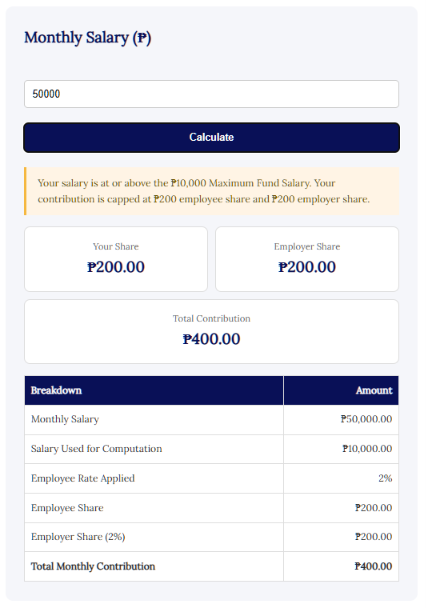
These percentages are applied to your salary up to the Maximum Fund Salary (MFS) of ₱10,000. Once your salary reaches or exceeds this amount, your contribution is fixed at the maximum, regardless of how much higher you actually earn.
| Item | 2026 Figure |
|---|---|
| Maximum Fund Salary (MFS) | ₱10,000 |
| Maximum employee share | ₱200/month |
| Maximum employer share | ₱200/month |
| Maximum total monthly contribution | ₱400/month |
Use the Free Pag-IBIG Contribution Calculator
Enter your monthly salary below to see your exact employee share, employer share, and total monthly contribution.
How to Compute Your Monthly Contribution
- Take your monthly salary.
- Cap it at ₱10,000 if it’s higher. Anything above ₱10,000 doesn’t add to your contribution.
- Check which rate applies. If your salary is ₱1,500 or below, use 1% for your share. If it’s above ₱1,500, use 2%.
- Multiply the capped salary by your rate. This is the amount deducted from your pay.
- Your employer separately contributes 2% of the same capped salary, on top of your pay.
Sample Computations at Different Salary Levels
| Monthly Salary | Your Share | Employer Share | Total |
|---|---|---|---|
| ₱1,200 | ₱12.00 (1%) | ₱24.00 (2%) | ₱36.00 |
| ₱6,500 | ₱130.00 (2%) | ₱130.00 (2%) | ₱260.00 |
| ₱15,000 | ₱200.00 (capped) | ₱200.00 (capped) | ₱400.00 |
Let’s say you earn ₱6,500 a month. Since this is above ₱1,500 and below the ₱10,000 cap, your contribution is straightforward: 2% of ₱6,500, which is ₱130 deducted from your pay, matched by another ₱130 from your employer.
Why Pag-IBIG Feels Different From SSS and PhilHealth
You may notice this is by far your smallest mandatory deduction, and that’s intentional. Think of it like a savings account with a low forced monthly deposit, rather than an insurance premium sized to your income. The ₱10,000 salary cap means high earners and moderate earners often pay the exact same ₱200, unlike SSS, which scales up to a ₱35,000 salary credit, or PhilHealth, which scales up to ₱100,000.
This is also why many members choose to contribute more voluntarily through Modified Pag-IBIG II (MP2), a separate optional savings program with historically higher dividend rates than the mandatory fund.
Self-Employed, Voluntary, and Kasambahay Members
If you’re self-employed or a voluntary member, you shoulder both the employee and employer shares yourself, for a combined 4% up to the same ₱10,000 cap, meaning a maximum of ₱400 a month.
Kasambahay (household worker) contributions follow a special rule under the Kasambahay Law. If a household worker earns below ₱5,000 a month, the household employer shoulders the full contribution. Above that threshold, the kasambahay contributes their own 2% share like a regular employee.
What Your Contribution Actually Builds
- Total Accumulated Value (TAV): your combined employee and employer contributions, plus dividends, which you can withdraw after a set membership period or upon qualifying events like retirement
- Pag-IBIG Housing Loan eligibility: access to below-market mortgage rates for home purchase, construction, or renovation
- Multi-Purpose Loan (MPL): a short-term loan based on your accumulated savings, usable for emergencies, education, or minor home improvements
- Calamity Loan: a low-interest loan available to members in officially declared calamity areas
Unlike SSS and PhilHealth, your Pag-IBIG contributions aren’t “spent” on shared insurance pools. They accumulate under your name and continue earning annual dividends, which is why many Filipinos treat their Pag-IBIG savings as a long-term forced savings account.
Frequently Asked Questions
Did the Pag-IBIG contribution rate increase in 2026?
No. The current rates under HDMF Circular No. 460 took effect in February 2024 and remain unchanged into 2026.
Why is my Pag-IBIG deduction only ₱200 even though I earn more than ₱10,000?
Pag-IBIG contributions are computed on salary only up to the ₱10,000 Maximum Fund Salary. Anything you earn above that doesn’t increase your mandatory contribution.
Can I contribute more than the mandatory amount?
Yes, through Modified Pag-IBIG II (MP2), a separate voluntary savings program that lets you contribute more and typically earns higher dividends than the mandatory fund.
Is my Pag-IBIG contribution tax-deductible?
Yes. Like your SSS and PhilHealth shares, your Pag-IBIG employee contribution is deducted from your gross pay before your BIR withholding tax is computed.
When can I withdraw my Pag-IBIG savings?
Typically after 20 years of membership, or earlier if you qualify under specific conditions such as retirement, permanent departure from the country, or total disability.
Final Thoughts
Pag-IBIG might be your smallest government deduction, but it’s the one that comes back to you directly, with dividends, and with real loan benefits attached. Between the low mandatory cap and the optional MP2 program, it’s worth understanding both what you’re required to contribute and what additional savings options are available to you.
With this, we’ve now covered all three mandatory government contributions alongside your withholding tax. Next, we’ll pull everything together into a complete take-home pay guide, followed by the pillar page linking this entire series.
Related Articles

PhilHealth Contribution Guide: Rates and Calculator

SSS Contribution & How It’s Computed (With Calculator)