Every payday, a portion of your salary goes straight to the Bureau of Internal Revenue (BIR) before it even reaches your bank account. This is your withholding tax on compensation, and if you earn ₱20,833 or less a month, you likely pay none of it at all.
In this guide, you’ll learn exactly how your employer computes this deduction, see the full 2026 BIR tax table, and walk through real peso examples so you can check your own payslip.
- What Is Withholding Tax on Compensation?
- What Counts as Taxable Compensation?
- The 2026 BIR Monthly Withholding Tax Table
- Use the Free Withholding Tax Calculator
- How to Manually Compute Your Monthly Withholding Tax
- Sample Computations at Different Salary Levels
- What About 13th Month Pay and Bonuses?
- Year-End Annualization (Why You Might Get a Refund)
- Common Mistakes to Avoid
- Frequently Asked Questions
- Final Thoughts
What Is Withholding Tax on Compensation?
Withholding tax on compensation is the income tax your employer deducts from your salary and remits to the BIR on your behalf, every payday. In simple terms, instead of you paying your full annual income tax in one lump sum, your employer collects it gradually throughout the year.
This system is governed by the TRAIN Law (RA 10963). Its second phase of rates took effect on January 1, 2023, and those same rates still apply in 2026. There’s no new tax table this year, so if your payslip looks the same as last year’s, that’s expected.
What Counts as Taxable Compensation?
Your withholding tax isn’t computed on your full gross salary. It’s computed on your taxable compensation, which is your gross pay minus a few specific deductions.
Deducted before tax is applied:
- Your SSS, PhilHealth, and Pag-IBIG employee contributions
- 13th month pay and other bonuses, up to a combined ₱90,000 per year
- De minimis benefits within BIR limits (rice subsidy, uniform allowance, medical cash allowance, laundry allowance, and similar small perks)
- Mandatory contributions to retirement funds
- Overtime pay, night shift differential, holiday pay, and hazard pay, if you’re a minimum wage earner
Let’s say you earn ₱30,000 gross per month, with ₱1,800 in combined SSS, PhilHealth, and Pag-IBIG contributions. Your taxable compensation is ₱28,200, not ₱30,000. That difference matters because it can push you into a lower bracket or reduce the tax within your current one.
The 2026 BIR Monthly Withholding Tax Table
This is the table your employer uses if you’re paid monthly. It has been in effect since January 2023 and remains unchanged for 2026.
| Monthly Taxable Compensation | Withholding Tax |
|---|---|
| ₱20,833 and below | ₱0 (exempt) |
| ₱20,833 – ₱33,332 | 15% of the excess over ₱20,833 |
| ₱33,333 – ₱66,666 | ₱1,875 + 20% of the excess over ₱33,333 |
| ₱66,667 – ₱166,666 | ₱8,541.80 + 25% of the excess over ₱66,667 |
| ₱166,667 – ₱666,666 | ₱33,541.80 + 30% of the excess over ₱166,667 |
| ₱666,667 and above | ₱183,541.80 + 35% of the excess over ₱666,667 |
If you’re paid semi-monthly (twice a month, which is common in the Philippines), your employer uses a separate semi-monthly table with the same rates applied to half the brackets. Your HR or payroll team can confirm which table applies to you.
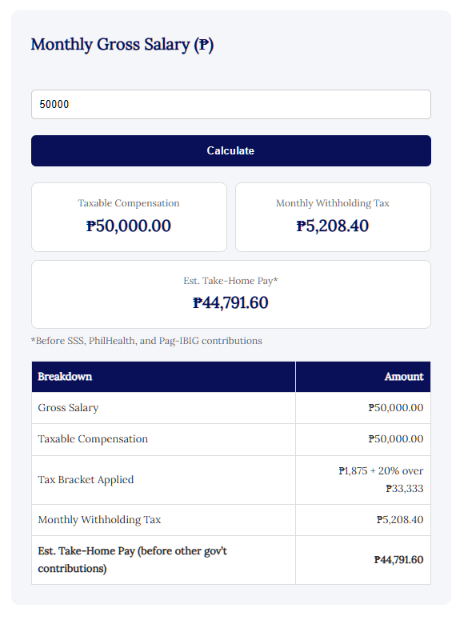
Use the Free Withholding Tax Calculator
Doing this math by hand every time isn’t necessary. We built a free calculator that applies the correct 2026 bracket automatically and shows you your monthly withholding tax and estimated take-home pay.
How to Manually Compute Your Monthly Withholding Tax
Here’s the process your payroll system follows, step by step:
- Start with your gross monthly compensation. This includes basic salary, taxable allowances, and any taxable overtime.
- Subtract your mandatory contributions. Deduct your SSS, PhilHealth, and Pag-IBIG employee shares.
- Subtract non-taxable items. Remove de minimis benefits and any 13th month pay or bonus portion still within the ₱90,000 annual ceiling.
- This gives you your taxable compensation. Match this figure to the correct bracket in the table above.
- Apply the bracket formula. Add the fixed amount for that bracket to the percentage applied to the excess over the bracket’s floor.
Sample Computations at Different Salary Levels
Here’s how the math plays out at a few common salary levels. Each example assumes SSS, PhilHealth, and Pag-IBIG contributions have already been deducted.
| Taxable Compensation | Bracket | Monthly Withholding Tax |
|---|---|---|
| ₱18,000 | Exempt | ₱0 |
| ₱25,000 | 15% over ₱20,833 | ₱625.05 |
| ₱40,000 | ₱1,875 + 20% over ₱33,333 | ₱3,208.40 |
| ₱80,000 | ₱8,541.80 + 25% over ₱66,667 | ₱11,875.05 |
Think of it like a staircase. You don’t pay the top rate on your entire salary, only on the portion that falls within each higher step. That’s why the fixed amount at the start of each bracket already accounts for everything below it.
What About 13th Month Pay and Bonuses?
Your 13th month pay and other bonuses are non-taxable up to a combined ₱90,000 per year. If your total bonuses for the year exceed this amount, only the excess is added back to your taxable income and subjected to withholding tax.
For example, if you receive ₱95,000 in combined 13th month pay and other bonuses in a year, only ₱5,000 of that gets taxed. This is a fixed, well-established rule under the TRAIN Law and has not changed for 2026.
Year-End Annualization (Why You Might Get a Refund)
Your employer withholds tax every payday based on estimates, but your actual annual tax due is only known at year-end, once your total income for the year is final. This is why employers perform year-end annualization in December: they total up everything you earned, compute your correct annual tax using the annual bracket table, then compare it to what was already withheld.
- If too much was withheld during the year, you get a refund, usually added to your December pay.
- If too little was withheld, for example because you got a mid-year raise or bonus, the shortfall is deducted from your December pay.
This annualization is also why your December payslip often looks different from the rest of the year. It’s normal, and it’s what your BIR Form 2316 (your annual certificate of compensation and tax withheld) will reflect.
Common Mistakes to Avoid
- Using gross salary instead of taxable compensation. Always subtract mandatory contributions first.
- Reading the wrong payroll frequency table. A semi-monthly earner should never be checked against the monthly table.
- Referencing the old 2018–2022 table. Those rates were higher and are no longer in effect.
- Forgetting the ₱90,000 bonus ceiling when estimating your year-end tax position.
- Assuming your payslip’s “tax” line already accounts for everything. Always check what your employer used as the taxable base.
Frequently Asked Questions
Is the 2026 withholding tax table different from 2025?
No. The rates have been the same since January 2023 under the second phase of the TRAIN Law. There is no new schedule for 2026.
Do I still pay withholding tax if I earn minimum wage?
No. Minimum wage earners are exempt from withholding tax on their basic pay, as well as on holiday pay, overtime pay, night shift differential, and hazard pay.
Is my SSS, PhilHealth, and Pag-IBIG contribution taxed?
No. These mandatory contributions are deducted from your gross pay before withholding tax is computed, so they reduce your taxable compensation rather than getting taxed themselves.
Can I get a tax refund if too much was withheld?
Yes. This is typically settled automatically through year-end annualization, and any excess is refunded through your December pay.
Where can I verify the official BIR tax table?
You can check the current rates directly on the BIR’s official tax information page at bir.gov.ph.
Final Thoughts
Withholding tax can feel like a mystery deduction on your payslip, but the math behind it is straightforward once you know your taxable compensation and the right bracket. Understanding this also helps you plan around raises, bonuses, and year-end pay, since crossing into a new bracket doesn’t mean your entire salary gets taxed at the higher rate.
Next in this series, we’ll break down your SSS, PhilHealth, and Pag-IBIG contributions individually, the three deductions that reduce your taxable compensation in the first place.
Related Articles

Pag-IBIG Contribution: Your Complete Guide With Calculator

PhilHealth Contribution Guide: Rates and Calculator