Your PhilHealth contribution is 5% of your monthly basic salary, split evenly between you and your employer, so you personally pay 2.5%. This is the final scheduled rate under the Universal Health Care (UHC) Law, and it hasn’t changed for 2026.
In this guide, you’ll see exactly how this 5% is computed, what the salary floor and ceiling mean for your contribution, and how PhilHealth compares to your SSS and tax deductions.
- What Is the PhilHealth Contribution?
- The 2026 PhilHealth Contribution Rate
- Use the Free PhilHealth Contribution Calculator
- How to Compute Your Monthly Premium
- Sample Computations at Different Salary Levels
- Why the Floor and Ceiling Matter
- Self-Employed, Voluntary, and OFW Members
- What Your Contribution Actually Covers
- Frequently Asked Questions
- Final Thoughts
What Is the PhilHealth Contribution?
PhilHealth (the Philippine Health Insurance Corporation) is the government’s national health insurance program. Every month, a percentage of your salary goes toward this fund, which subsidizes hospital confinements, certain outpatient procedures, and other covered medical costs for you and your qualified dependents.
In simple terms, this deduction works like a shared national health insurance premium. Unlike SSS, which uses fixed salary brackets, PhilHealth applies a straightforward percentage directly to your monthly basic salary, within a set floor and ceiling.
The current rate is governed by RA 11223, the Universal Health Care Act, which scheduled yearly increases starting at 2.75% in 2019 until reaching its final rate. That final rate, 5%, took effect and has remained unchanged into 2026.
The 2026 PhilHealth Contribution Rate
| Item | 2026 Rate |
|---|---|
| Total contribution rate | 5% of monthly basic salary |
| Employee share | 2.5% |
| Employer share | 2.5% |
| Salary floor | ₱10,000 |
| Salary ceiling | ₱100,000 |
| Minimum total premium | ₱500/month |
| Maximum total premium | ₱5,000/month |
Use the Free PhilHealth Contribution Calculator
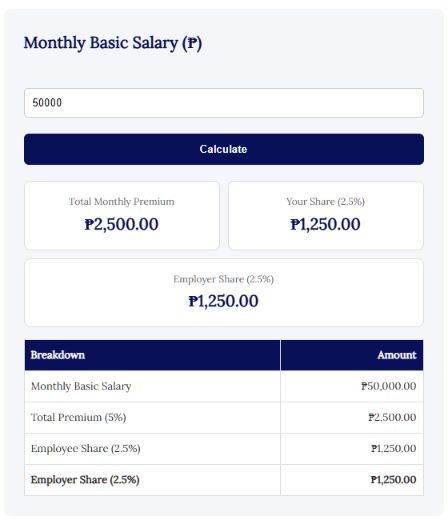
Enter your monthly salary below to see your total premium and your exact employee share.
How to Compute Your Monthly Premium
- Take your monthly basic salary.
- Check if it falls within ₱10,000 to ₱100,000. If it’s below ₱10,000, your premium is fixed at ₱500 total. If it’s ₱100,000 or above, your premium is fixed at ₱5,000 total.
- If it falls within the range, multiply your salary by 5%. This is your total monthly premium.
- Divide that total by two. Half is deducted from your pay, and the other half is shouldered by your employer.
Sample Computations at Different Salary Levels
| Monthly Salary | Total Premium (5%) | Your Share |
|---|---|---|
| ₱8,000 | ₱500 (floor applies) | ₱250 |
| ₱20,000 | ₱1,000 | ₱500 |
| ₱30,000 | ₱1,500 | ₱750 |
| ₱60,000 | ₱3,000 | ₱1,500 |
| ₱120,000 | ₱5,000 (ceiling applies) | ₱2,500 |
Let’s say you earn ₱30,000 a month. Your total premium is ₱1,500 (5% of ₱30,000). You personally see ₱750 deducted from your payslip, and your employer separately contributes the other ₱750 on your behalf.
Why the Floor and Ceiling Matter
Unlike SSS, which uses fixed ₱500 brackets, PhilHealth applies its 5% rate as a straight percentage, but only within a defined range. Think of it like a speed limit with a minimum and maximum: below ₱10,000, your premium doesn’t drop any lower than ₱500 total, protecting minimum wage earners from having close to nothing collected. Above ₱100,000, your premium doesn’t climb any higher than ₱5,000 total, capping the burden on high-income earners.
This means two employees earning ₱150,000 and ₱300,000 a month pay the exact same ₱2,500 employee share, since both are above the ceiling.
Self-Employed, Voluntary, and OFW Members
If you don’t have an employer to split the cost with, you shoulder the full 5% yourself, based on your declared monthly income. The same ₱10,000 floor and ₱100,000 ceiling apply. A self-employed member earning ₱30,000 a month, for example, pays the full ₱1,500 total, compared to the ₱750 an equivalent employed worker pays.
Voluntary and self-employed members can pay monthly, quarterly, semi-annually, or annually through accredited PhilHealth payment channels, including GCash, debit, and credit cards.
What Your Contribution Actually Covers
Your PhilHealth premium helps fund coverage for:
- Hospital room and board, within case rate limits, at PhilHealth-accredited hospitals
- Doctor’s professional fees during covered confinements
- Selected outpatient procedures, including dialysis, chemotherapy, and certain surgeries
- The Konsulta Package, covering primary care consultations and selected medicines at accredited providers
- Coverage extended to your qualified dependents, such as your spouse, children, and qualified parents
Your actual out-of-pocket cost during a hospital stay depends on the case rate, whether the hospital is PhilHealth-accredited, and whether the facility follows the No Balance Billing policy for qualifying patients.
Frequently Asked Questions
Did the PhilHealth rate increase in 2026?
No. The 5% rate is the final scheduled adjustment under the UHC Law and has stayed the same into 2026.
Is there a maximum PhilHealth contribution?
Yes. Once your monthly salary reaches ₱100,000, your premium is capped at ₱5,000 total, split ₱2,500 each between you and your employer.
Is my PhilHealth contribution tax-deductible?
Yes. Like SSS, your PhilHealth employee share is deducted from your gross pay before your BIR withholding tax is computed, reducing your taxable compensation.
Does PhilHealth cover my dependents too?
Yes, qualified dependents such as your legal spouse, children under 21 (or any age if disabled), and qualified parents can be covered under your membership.
Final Thoughts
PhilHealth’s straightforward 5% rate makes it one of the easier government deductions to compute, but the floor and ceiling are worth knowing so you’re not caught off guard by a payslip figure that looks “off” at either end of the salary scale. Combined with your SSS and withholding tax, this deduction is part of what determines your true take-home pay.
Next in this series, we’ll cover your Pag-IBIG contribution, the last of the three mandatory government deductions before we put together the full take-home pay picture.
Related Articles

Pag-IBIG Contribution: Your Complete Guide With Calculator

SSS Contribution & How It’s Computed (With Calculator)