Your SSS contribution is 5% of your Monthly Salary Credit (MSC), deducted from your pay every month, with your employer chipping in another 10% on your behalf. For most employees, that works out to somewhere between ₱250 and ₱1,750 a month, depending on how much you earn.
In this guide, you’ll see the full 2026 SSS contribution table, learn how your salary maps to an MSC bracket, and understand exactly what that deduction is buying you.
- What Is the SSS Contribution?
- What Is Monthly Salary Credit (MSC)?
- Use the Free SSS Contribution Calculator
- The Full 2026 SSS Contribution Table
- How to Find Your Own Contribution
- Why There Are Two Different Salary Caps
- What Your Contribution Actually Buys You
- How to Verify Your Contribution Record
- Frequently Asked Questions
- Final Thoughts
What Is the SSS Contribution?
The Social Security System (SSS) is the government’s social insurance program for private sector employees, self-employed individuals, and voluntary members. Every month, a percentage of your salary is set aside to fund benefits like sickness pay, maternity leave, disability support, unemployment assistance, and your eventual retirement pension.
In simple terms, this deduction is not a tax. It’s a forced savings and insurance program that pays out benefits when you need them, and eventually funds part of your pension.
For 2026, the total contribution rate is 15% of your MSC, split between you and your employer under RA 11199 (the Social Security Act of 2018). This 15% rate reached its final scheduled step-up in January 2025 and carries over unchanged into 2026.
What Is Monthly Salary Credit (MSC)?
SSS doesn’t compute your contribution on your exact salary. Instead, it maps your salary to the nearest ₱500 bracket, called your Monthly Salary Credit. Think of it like a shelf: your salary gets placed on the nearest ₱500 shelf, and that shelf amount, not your exact peso salary, is what gets multiplied by 15%.
For 2026, MSC ranges from a floor of ₱5,000 to a ceiling of ₱35,000. Let’s say you earn ₱24,300 a month. Your MSC lands on ₱24,500, and your contribution is computed from that bracket, not your exact ₱24,300.
Use the Free SSS Contribution Calculator
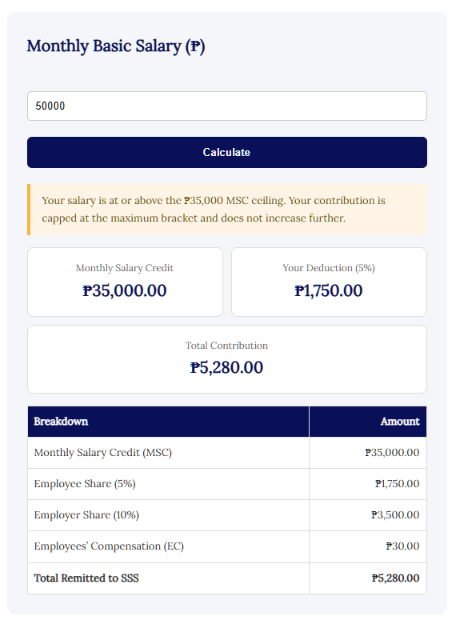
Skip the bracket-hunting. Enter your monthly salary below and the calculator finds your exact MSC, employee share, employer share, and total contribution.
The Full 2026 SSS Contribution Table
Find your monthly salary range in the first column, then read across for your MSC, employee share (EE), employer share (ER), the Employees’ Compensation premium (EC), and the total remitted to SSS.
| Salary Range | MSC | Employee (5%) | Employer (10%) | EC | Total |
|---|---|---|---|---|---|
| ₱0 – ₱5,249.99 | ₱5,000 | ₱250.00 | ₱500.00 | ₱10.00 | ₱760.00 |
| ₱9,750 – ₱10,249.99 | ₱10,000 | ₱500.00 | ₱1,000.00 | ₱10.00 | ₱1,510.00 |
| ₱14,750 – ₱15,249.99 | ₱15,000 | ₱750.00 | ₱1,500.00 | ₱30.00 | ₱2,280.00 |
| ₱19,750 – ₱20,249.99 | ₱20,000 | ₱1,000.00 | ₱2,000.00 | ₱30.00 | ₱3,030.00 |
| ₱24,750 – ₱25,249.99 | ₱25,000 | ₱1,250.00 | ₱2,500.00 | ₱30.00 | ₱3,780.00 |
| ₱29,750 – ₱30,249.99 | ₱30,000 | ₱1,500.00 | ₱3,000.00 | ₱30.00 | ₱4,530.00 |
| ₱34,750 and above | ₱35,000 | ₱1,750.00 | ₱3,500.00 | ₱30.00 | ₱5,280.00 |
This is a shortened view of the full bracket table, which moves in ₱500 increments across the entire ₱5,000 to ₱35,000 range. Use the calculator further down this page to get your exact bracket without scrolling through every row.
How to Find Your Own Contribution
- Take your monthly basic salary. Bonuses and 13th month pay are not included, since SSS is computed on regular monthly basic pay only.
- Round up to the nearest ₱500 bracket using the table above to find your MSC.
- Multiply your MSC by 5%. That’s your employee share, the amount deducted from your payslip.
- Your employer separately pays 10% of the same MSC, plus a small EC premium. This doesn’t come out of your salary.
Why There Are Two Different Salary Caps
This is where most confusion comes from. SSS actually has two separate ceilings that apply at different times:
- ₱35,000 is the contribution-posting ceiling. Your monthly deduction is capped here, so anyone earning ₱35,000 or more still pays the same fixed employee share of ₱1,750.
- ₱20,000 is the Regular SS benefit-computation cap. This applies specifically to short-term benefits like sickness, maternity, disability, and unemployment.
If your MSC is above ₱20,000, the portion of your contribution on the excess doesn’t go toward those short-term benefits. Instead, it funds your MPF (Mandatory Provident Fund), also branded as the MySSS Pension Booster, a separate individual account that adds an extra layer to your eventual retirement pension.
What Your Contribution Actually Buys You
Your SSS contribution funds a mix of short-term and long-term benefits:
- Sickness benefit for extended illness, up to 120 days a year
- Maternity benefit covering 105 to 120 days, depending on delivery type
- Disability benefit, either a pension or lump sum depending on severity
- Unemployment benefit, a limited payout if you’re involuntarily separated from work
- Retirement pension, a lifetime monthly payout once you meet age and contribution requirements
- Funeral and death benefits for your beneficiaries
- Salary loan eligibility, based on your average MSC over the past 12 months
Separately, your employer’s EC premium funds the Employees’ Compensation Program, which covers work-related injury, illness, or death. This is entirely employer-funded and doesn’t reduce your take-home pay.
How to Verify Your Contribution Record
Your My.SSS account at member.sss.gov.ph is the authoritative record of everything remitted on your behalf. It’s worth checking every few months, since posting typically lags 30 to 45 days behind the actual contribution month.
If your payslip shows an SSS deduction for a given month but My.SSS shows nothing posted after 60 days, that’s worth escalating. It could mean your employer deducted the amount but hasn’t remitted it, which is a violation of RA 11199 that you can report through any SSS branch or the SSS hotline.
Frequently Asked Questions
Did SSS contributions increase in 2026?
No. The 15% rate took effect in January 2025 as the final scheduled step-up under RA 11199, and it carries over unchanged into 2026. If your deduction changed recently, it’s more likely due to a salary increase moving you into a new MSC bracket, not a rate change.
Are bonuses and 13th month pay included in the SSS computation?
No. SSS contributions are based on your regular monthly basic salary only.
Is my SSS contribution tax-deductible?
Yes. Your 5% employee share is deducted from your gross pay before your BIR withholding tax is computed, which reduces your taxable compensation.
Can I choose my own MSC bracket?
Not as an employee. Your MSC is set by your actual salary. Self-employed, voluntary, and OFW members can choose their MSC within the ₱5,000 to ₱35,000 range.
Final Thoughts
Your SSS deduction might look like just another line on your payslip, but it’s building toward real benefits you can claim during sickness, maternity, disability, or eventually, retirement. Knowing how your salary maps to an MSC bracket also helps you understand why a small raise sometimes doesn’t change your deduction at all, while other times it bumps you into the next bracket entirely.
Next in this series, we’ll walk through your PhilHealth contribution, another mandatory deduction that reduces your taxable compensation.
Related Articles

Pag-IBIG Contribution: Your Complete Guide With Calculator

PhilHealth Contribution Guide: Rates and Calculator