Small claims is the simplest way to collect money someone owes you in the Philippines, as long as the claim is ₱1,000,000 or below (not counting interest and costs) and all you want is the money back. You file at your local first level court, you do not need a lawyer, and the judge hears your case in a single sitting. In simple terms, it is the “people’s court” for unpaid loans, rent, services, and similar debts.
I went through this process myself as the plaintiff. I filed in July 2026, negotiated with the defendant in court, and later had to ask for execution when the payments stopped. This guide walks you through every stage in order and includes what I actually experienced along the way, so you know what to expect before you walk into the court.
Quick note. This is a general guide based on the Supreme Court’s 2022 Rules on Expedited Procedures in the First Level Courts and my own experience. Some steps, like e-filing by email, depend on how your court operates. I am not a lawyer, so always confirm the details with the Clerk of Court of your MTC, MTCC, or MeTC.
- What Is Small Claims and Who Can Use It?
- Which Cases Qualify (and Which Do Not)?
- What Must You Do Before Filing?
- How Do You Prepare Your Statement of Claim and Attachments?
- How Do You File and Pay the Fees?
- What Happens After Filing? (Raffle, Summons, and Hearing Date)
- What Happens at the Hearing?
- What Does the Court Order Look Like?
- What If the Defendant Stops Paying?
- How Does the Sheriff Collect from the Defendant?
- How Much Does It Cost and How Long Does It Take?
- Common Mistakes to Avoid
- Frequently Asked Questions
- Final Thoughts
What Is Small Claims and Who Can Use It?
A small claim is a purely civil case where the only thing you are asking for is the payment or reimbursement of a sum of money. It is handled by the first-level courts, which are the Metropolitan Trial Courts (MeTC), Municipal Trial Courts in Cities (MTCC), Municipal Trial Courts (MTC), and Municipal Circuit Trial Courts (MCTC).
The process is designed to be fast and low cost. Lawyers are not allowed to represent either side at the hearing (unless the lawyer is the plaintiff or defendant personally), the forms are standardized, and the judge is expected to decide within 24 hours after the hearing ends. Think of it like a shortcut version of a regular court case, with most of the paperwork and delays removed.
Which Cases Qualify (and Which Do Not)?
The maximum claim is ₱1,000,000, exclusive of interest and costs. This applies nationwide, whether you file in Metro Manila or in the provinces. The claim must come from one of the following.
- A contract of loan or other credit arrangement (for example, a personal loan or unpaid installment).
- A contract of lease (for example, unpaid rent).
- A contract of services (for example, a freelancer who was never paid).
- A contract of sale of personal property (for example, goods delivered but not paid for).
- Enforcement of a barangay amicable settlement or arbitration award, within the limits set by the rules.
Small claims does not cover cases where you want something other than money, such as getting back land or a house, or cases that come with provisional remedies. You also cannot split one big claim into several small cases just to stay under the limit. The Statement of Claim even includes a certification against splitting a single cause of action.
| Situation | Small claims? |
|---|---|
| Friend borrowed ₱150,000 and stopped paying | Yes |
| Client never paid a ₱80,000 freelance invoice | Yes |
| Tenant owes ₱120,000 in unpaid rent | Yes, for the unpaid rent |
| Debt of ₱1,500,000 | No, unless you waive the excess. Otherwise it goes under summary or regular procedure |
| You want a borrowed car returned | No, this is not a money claim |
What Must You Do Before Filing?
Courts can dismiss a small claim on their own if a condition that should have been met before filing was skipped. In my case, the court clearly required one major step, which was sending a demand letter. There is also a second possible step, barangay conciliation, depending on where you and the defendant live.
Step 1. Send a Demand Letter with a Summary of Claim
Before you file anything, the defendant must receive a written demand from you. The letter should state the amount owed, how you computed it, and a deadline to pay. I attached a Summary of Claim to the letter so the defendant could see exactly how the total was computed.
My experience. I sent the demand letter and Summary of Claim by courier (LBC) and waited until it was delivered before filing. The court wanted the courier official receipt and the tracking entries attached to my e-filing as proof of delivery. Do not file until the tracking shows the letter was delivered.
Step 2. Check If Barangay Conciliation Applies
Under the Local Government Code, disputes between people who live in the same city or municipality generally have to go through the barangay (Katarungang Pambarangay) first. If that applies to you, you need a certificate showing you tried conciliation. Filing without it can get your case dismissed without prejudice, which means you can refile after complying. In my case, since I and the defendant live in different provinces, barangay conciliation was not applicable. There are exceptions, so ask the Clerk of Court if you are unsure.
Step 3. Check the Prescription Period
You cannot wait forever. Under the Civil Code, an action based on a written contract generally prescribes in 10 years, while an action based on an oral contract generally prescribes in 6 years, counted from when you could first have sued. A claim barred by the statute of limitations is a ground for the court to dismiss your case.
How Do You Prepare Your Statement of Claim and Attachments?
You do not need to write a complicated complaint. A small claim starts with a standard court form called the Statement of Claim (Form 1-SCC), together with a Verification and Certification Against Forum Shopping, Splitting a Single Cause of Action, and Multiplicity of Suits. You attach certified copies of your documents, affidavits of your witnesses (which can be just you), and any other evidence. If you are filing for a business, a board resolution or secretary’s certificate is also needed.
Include your interest in the Statement of Claim. If you want interest on top of the principal, write it down in your claim, with the rate and the amount. The judge will only award what you actually asked for. If you leave interest out, you cannot expect the court to add it later.
Evidence matters a lot here. Any evidence you do not attach to your Statement of Claim cannot be used at the hearing unless you show good cause. So attach everything up front. The form also asks whether you are engaged in the business of lending or banking, and how many small claims you have filed this year. Answer honestly, because a false answer can get your case dismissed with prejudice.
The Attachments I Submitted
Here is the list of attachments in my e-filing, which may give you a useful checklist for your own case. I made Items 7 – 11 based on my personal situation; they may or may not be applicable to your case.
| No. | Attachment | What it is for |
|---|---|---|
| 1 | Statement of Claim | The main court form stating your claim, including any interest |
| 2 | Affidavit | Your sworn statement of the facts |
| 3 | Demand Letter with Summary of Claim | Proof that you demanded payment first |
| 4 | LBC Official Receipt and Track Entries | Proof that the demand letter was sent and delivered |
| 5 | Summary of Claim | A clear computation of what is owed |
| 6 | Exhibits | The labeled evidence package |
| 7 | Signed Debt Agreement | The actionable document showing the obligation |
| 8 | Breakdown of Original Debt | How the original amount was made up |
| 9 | Statement of Account | The running balance after payments |
| 10 | Proof of Payments Received | Shows what the defendant already paid |
| 11 | Defendant’s Acknowledgement of Debt, Promises to Pay, and Missed Payments | Messages and records showing the defendant admitted the debt |
| 12 | JEPS Official Receipt | Proof that the court fees were paid |
Preparing these attachments properly can make or break your case, so I will cover how to organize and label them in a separate guide.
How Do You File and Pay the Fees?
Where and how to file depends on the court, but the usual rule on venue applies. Your case is generally filed in the first-level court where you or the defendant lives. Many courts now accept e-filing, so it is worth asking the Clerk of Court how they want filings submitted.
My experience. I first went to the Municipal Trial Court in Cities (MTCC) in person to ask about the process. The staff checked my paperwork and told me to e-file. While I was there, I was asked to pay the fees first, because the official receipt (JEPS OR) is also required in the e-filing. I then emailed all my attachments to the court. The submission form had the fields shown in the screenshot below.
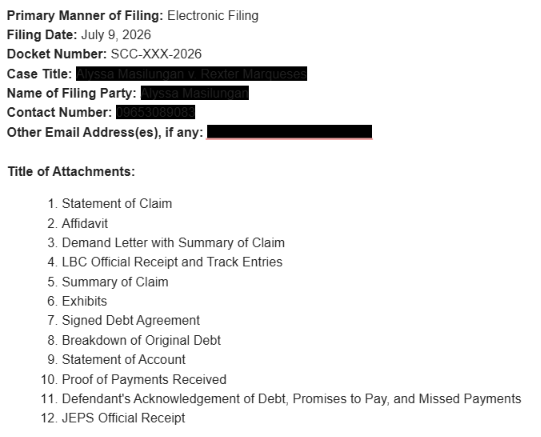
The e-filing form asked for the following.
- Primary manner of filing (mine was personal filing).
- Filing date.
- Docket number, which follows the format SCC-[number]-[year] for small claims cases (provided to me when I visited the court)
- Case title, written as the plaintiff versus the defendant.
- Name of the filing party.
- Contact number and other email addresses, if any.
- Title of attachments, which is the list from the table above.
About the fees, the plaintiff pays the docket and other legal fees under Rule 141 of the Rules of Court, and the exact amount depends on the claim. Ask the Clerk of Court to assess it for you. The rules also require a ₱1,000 fee for service of summons and processes. Only the Supreme Court can grant a fee exemption, and a plaintiff who qualifies as indigent (through a motion to sue as an indigent) still pays that ₱1,000. If you file more than five small claims in a calendar year, additional fees apply.
What Happens After Filing? (Raffle, Summons, and Hearing Date)
The Raffle
In cities with more than one branch, your case is assigned by a raffle draw. In my city there are three trial courts, so the draw decided which branch would handle my case. In my city, cases are drawn once a week, so in my case, it took 6 days before I was informed of my branch assignment. After the draw, I simply waited for my hearing date.
Summons and the Defendant’s Response
Behind the scenes, the rules move quickly. If the court finds no ground for dismissal, it issues the summons within 24 hours from receipt of your Statement of Claim. A sheriff or court officer serves it, and the defendant has a non-extendible 10 calendar days from receipt to file a verified Response (Form 3-SCC) with their own evidence.
The notice of hearing is set no more than 30 calendar days from filing (60 days if a defendant lives or does business outside the judicial region). In real life, court workload can stretch this, so treat these as targets and not guarantees. In my case, the scheduled hearing coincided with multiple work cancellation due to typhoon, so the actual hearing took place 46 days after filing.
If summons cannot be served. The court may order you to serve it yourself, and you must tell the court within 30 calendar days whether it was served. If you do not, your claim can be dismissed without prejudice. You can refile within one year at reduced fees.
What Happens at the Hearing?
The hearing is the heart of small claims. You must appear personally, unless the court allows a representative for a valid reason (who cannot be a lawyer and needs a Special Power of Attorney). Missing the hearing has serious consequences. If the plaintiff does not appear, the claim is dismissed without prejudice. If the defendant does not appear, the court decides based on your claim and evidence. If neither appears, both the claim and any counterclaim are dismissed with prejudice. A postponement is allowed only once, and only for physical inability to appear.
The judge starts by explaining how small claims works, then actively tries to get both sides to settle. If you settle, the agreement is written down, signed, and submitted for approval right there. If you cannot settle, the judge hears the case informally and decides.
My experience. On the hearing date, the defendant and I negotiated a compromise agreement. Even though, as the plaintiff, I would have preferred to get the whole amount right away, the court was more inclined to support an installment arrangement that fit the defendant’s circumstances. If you are the plaintiff, go in expecting to be asked to be flexible.
Tips for the Negotiation
- Be ready with your computation, including principal, interest, and any payments already received.
- Remember that you may add the court fees you already paid to the amount covered by the compromise.
- Think about what installment size and schedule you can realistically accept before you walk in.
- You can ask the judge whether the agreement can say what happens if an installment is missed. The court decides what goes in the final order.
- Keep the settlement talks private. The rules require settlement discussions in small claims to be kept strictly confidential.
Let’s say the defendant owes ₱200,000 in principal, and you claimed 6% interest per year (₱12,000) plus ₱3,500 in court fees you paid. The total is ₱215,500. A realistic compromise might be 10 monthly payments of ₱21,550. This is only an illustration, but it shows how a court-friendly installment plan can still return everything you claimed.
What Does the Court Order Look Like?
Once the compromise is reached, the court issues an order based on it, which states how much will be paid, when each payment is due, and until when the payments will run. The court is expected to render judgment on the compromise within 24 hours. If a party agrees but does not sign, the court gives them three calendar days to confirm, and the agreement is deemed confirmed if they do not respond.
A small claims decision is final, executory, and unappealable. The only exception is a petition for certiorari on grounds like grave abuse of discretion, which is a different and harder remedy. That is why it pays to be careful before you sign anything.
What If the Defendant Stops Paying?
After the order, you wait for the payment schedule to run. If the defendant pays on time, great. Just wait for the next installment. If a payment is missed, you can file a Motion for Execution, which asks the court to enforce its own order.
My experience. The rules describe the motion for execution as ex parte, but in my case I still had to send the defendant the Motion for Execution form to inform them of my intent to file. Just like with the demand letter, the courier receipt and tracking were required as attachments. Once those were complete, I e-filed the motion again by email. Ask your court whether it requires the same notice.
How Does the Sheriff Collect from the Defendant?
Once your e-filing is acknowledged, the case is transferred to the sheriff. Here is what I went through, step by step.
- The sheriff estimates the cost. The sheriff estimates how much money is needed to garnish assets from the defendant. In my experience, this ranged from ₱5,000 to ₱10,000, and it is subject to liquidation. Any excess can be refunded.
- You pay the fee through e-filing again. After payment, I submitted the OR through e-filing just like in the previous steps. Since you are already in court, you might as well speak with the sheriff assigned in your MTC branch. This is where you discuss their steps and share anything you know about the defendant’s probable assets, such as where they bank or what they own. Real tips help the sheriff collect for you.
- The sheriff looks for assets. The sheriff typically contacts the Land Transportation Office (LTO), the Registry of Deeds (RD), and banks to ask for registered assets under the defendant’s name.
The big limit on garnishment. If the defendant already transferred an asset to another person, the sheriff cannot go after it directly, even if the defendant still uses it. You would have to prove to the court that the transfer was made to evade the garnishment, and that requires a separate case.
How Much Does It Cost and How Long Does It Take?
| Cost | Notes | Personal Experience (Collection Amount: ₱900k) |
|---|---|---|
| Docket and legal fees | Based on Rule 141 and your claim amount. Ask the Clerk of Court for the exact assessment | ₱16,193.40 |
| Service of summons and processes | Free | Free |
| Courier for demand letter and motion notice | Depends on the courier and the delivery location | ₱155 x 2 |
| Notarization of affidavits and verification | Varies by notary | ₱350 |
| Sheriff’s estimated expenses for execution | ₱5,000 to ₱10,000 in my case, subject to liquidation, with any excess refundable | ₱10,000 |
| Stage | What the rules say |
|---|---|
| Summons issued | Within 24 hours from receipt of the Statement of Claim |
| Summons served | Within 10 calendar days from issuance |
| Defendant’s Response | 10 calendar days from receipt of summons, non-extendible |
| Hearing date | Not more than 30 calendar days from filing (60 if a defendant is outside the judicial region) |
| Judgment | Within 24 hours after the hearing ends |
These are the targets in the rules. Actual waiting time varies by court, and collecting the money can take much longer than the case itself, especially when payments come in installments or you need execution.
Common Mistakes to Avoid
- Skipping the demand letter or filing before it was delivered.
- Forgetting to claim interest in the Statement of Claim. The judge will not add what you did not ask for.
- Leaving out evidence. Anything not attached to your filing may not be allowed at the hearing.
- Missing the hearing. Your case can be dismissed, and postponements are very limited.
- Bringing a lawyer to speak for you. Lawyers cannot appear for a party at the hearing.
- Splitting one debt into several cases to get under the ₱1,000,000 limit.
- Not tracking the defendant’s assets. Collect names of banks, vehicles, and property early, because it makes execution much easier.
Frequently Asked Questions
What is the maximum amount for a small claims case in the Philippines?
The limit is ₱1,000,000, not counting interest and costs, under the 2022 Rules on Expedited Procedures in the First Level Courts.
Do I need a lawyer to file a small claim?
No. Lawyers cannot appear on behalf of a party at the hearing, unless the lawyer is the plaintiff or defendant. You can still consult a lawyer beforehand to prepare your documents.
Can I file a small claim without a written contract?
You can try, but you will need other evidence of the debt, such as chat messages, bank transfers, or acknowledgment receipts. Written proof is much stronger, and oral agreements also have a shorter prescription period.
Can I collect interest in a small claims case?
Yes, but you must state it in your Statement of Claim. The court generally awards only what you prayed for. Courts can also reduce interest rates that they find excessive.
Can I appeal if I lose?
A small claims decision is final and unappealable. The only remedy is a petition for certiorari under Rule 65 on narrow grounds such as grave abuse of discretion, which is a different process.
What if the defendant ignores the summons?
If the defendant fails to file a Response and does not attend the hearing, the court decides based on your Statement of Claim and its attachments. If the defendant shows up without a Response, the court hears their defense on the same day.
What if the defendant has no assets?
A favorable judgment does not guarantee payment. If the sheriff cannot find assets, collection stalls. This is why sharing what you know about the defendant’s assets with the sheriff matters.
Can the defendant file a counterclaim?
Yes. A defendant can raise a counterclaim in the Response, and a compulsory counterclaim that is not raised is considered waived.
Final Thoughts
Small claims is not complicated, but it does reward preparation. Send a proper demand letter, wait for delivery, claim your interest, attach every piece of evidence, and show up ready to negotiate. In my case, the hardest part was not the hearing but the waiting that came after, which is why knowing the execution process in advance helps so much.
If you are owed money and the amount is within ₱1,000,000, this process is worth trying before anything more expensive. Visit your local MTC or MTCC, ask the clerk how they accept filings, and take it one step at a time.
This article is for general information only and is not legal advice. Court procedures and fees can vary by court and change over time. For concerns about your specific case, consult a lawyer or the Clerk of Court. Questions about this site can be sent to support@thedatacode.com.
Related Articles
Grid

How to Set Up and Use Apple Pay in the Philippines
How Do Small Claims Work in the Philippines? A Complete Step-by-Step Guide

Grab Dine Out Philippines: What It Is and How to Use It

Visa x Google Pay ₱1,500 Cashback Promo: Complete Guide

Government Salary Deductions: Complete Guide With Calculator