Maribank vs Tonik vs GoTyme vs CIMB vs UNO vs Komo
As of June 2026, Tonik and UNO Digital Bank offer the highest headline rates on locked-in time deposits (up to 5.50% p.a.), while BanKo and Tonik offer the strongest fully liquid savings rates (4.00% to 5.00% p.a.).
If you’ve been bouncing between digital banking apps trying to figure out where to park your savings, you’re not alone. Maribank, Tonik, GoTyme, CIMB, UNO Digital Bank, BanKo, and Komo all compete for the same Filipino savers, and they all advertise their rates a little differently (some daily, some monthly, some with conditions buried in the fine print). This guide puts all six side by side so you can compare apples to apples.
- Quick Comparison: Savings Account Rates
- Time Deposit Rate Comparison
- MariBank: How Does It Stack Up?
- Tonik: What's the Catch With "Up to 5.50%"?
- GoTyme: Is Go Save Worth It?
- CIMB: UpSave, GSave, or Prime?
- UNO Digital Bank: Why Do the Rates Look Different Everywhere?
- Komo: Is It Still Competitive in 2026?
- BanKo TODO Savings: What's the Catch With the 5.00%?
- Are All These Digital Banks Equally Safe?
- Which One Should You Actually Pick?
- Final Thoughts
- Related Articles
Quick Comparison: Savings Account Rates
These are the everyday, no-lock-in savings rates as advertised by each bank as of June 2026. “No conditions” means you earn the rate just by having money in the account, with no missions, spending requirements, or balance tiers to chase.
| Bank | Product | Base Rate (p.a.) | Conditions |
|---|---|---|---|
| GoTyme | Go Save | 3.00% | None. Flat rate, up to 5 Go Save buckets. |
| MariBank | Savings Account | 3.25% (up to ₱1M) / 3.75% (above ₱1M) | None. Tiered by balance, credited daily. |
| Tonik | Solo Stash | ~4.00% | None. Tonik Account (the basic wallet) only earns ~1.00%. |
| Tonik | Group Stash | Up to 4.50% | Needs 2+ participants saving toward a shared goal. |
| UNO Digital Bank | UNOready | 3.00% (3.50% with ₱5,000+ balance) | Higher tier needs a minimum daily balance. |
| CIMB | UpSave / GSave | 2.30% – 2.50% | None for the base rate. Promos can temporarily boost this. |
| Komo | Komo Savings | 2.50% | None, but no real promo upside either. |
| BanKo | TODO Savings | Up to 5% | PHP 5,000 to PHP 1M deposit to enjoy the 5% interest rate. |
Note: all rates here are gross, before the 20% withholding tax that applies to interest income from Philippine bank deposits. So a 3.00% p.a. rate actually nets you about 2.40% p.a. after tax.
Time Deposit Rate Comparison
If you don’t need the money for a few months, locking it into a time deposit gets you a noticeably higher rate than a regular savings account. Here’s how the six banks compare on their time deposit products.
| Bank | Product | Rate (p.a.) | Term |
|---|---|---|---|
| Tonik | Time Deposit | 4.50% – 5.50% (tiered by tenor) | 6 to 24 months |
| UNO Digital Bank | UNOboost | 4.25% – 5.50% (tiered by tenor) | Flexible tenors |
| UNO Digital Bank | UNOearn | Up to ~4.75% | 12 or 24 months, monthly payout |
| MariBank | Upfront Time Deposit | 3.75% | 3 months only, interest paid upfront |
| CIMB | MaxSave | 3.25% – 3.50% | Multiple tenors |
| GoTyme | USD Time Deposit | No published interest rate | USD only, multiple tenors |
| Komo | No time deposit product | N/A | N/A |
I know these tables can be confusing. To ease the hassle of calculating interest rates one at a time, you can use our interactive digital savings interest calculator. Simply input your target savings amount.
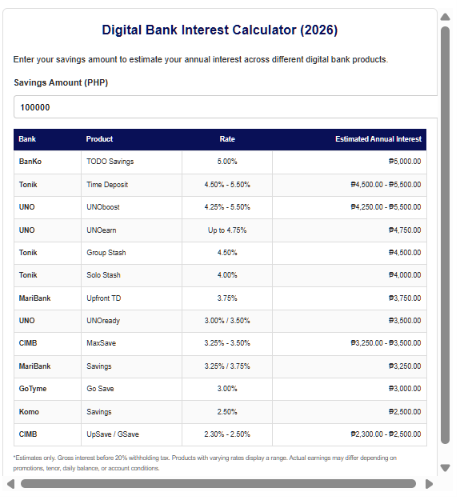
MariBank: How Does It Stack Up?
MariBank (formerly SeaBank, now under Sea Group, the company behind Shopee) pays 3.25% p.a. on balances up to ₱1,000,000 and 3.75% p.a. on anything above that, credited daily with no maintaining balance and no missions. This rate was cut from a higher level on January 15, 2026, but it’s still one of the simplest “deposit and forget” options on this list. MariBank also recently rolled out a 3-month time deposit with an unusual feature: it pays the net interest upfront when you open it, instead of at maturity.
We cover MariBank in more depth, including a full interactive interest calculator, in our dedicated MariBank guide with calculator. If you’ve already decided MariBank is the one, that’s the better place to model your actual numbers.
Tonik: What’s the Catch With “Up to 5.50%”?
Tonik’s headline 5.50% p.a. rate only applies to a 12-month time deposit. Money sitting in your basic Tonik Account earns just 1.00% p.a., the lowest “default” rate among the six banks. The better everyday options are Solo Stash (around 4.00% p.a., for personal savings goals) and Group Stash (up to 4.50% p.a., if you’re saving with at least one other person).
Worth knowing: Tonik has revised its time deposit rates more than once in 2026, first cutting the ADB requirement for the 6% (6-month) tier in February, then adjusting rates again in May and June. If you’re opening a time deposit specifically for the headline rate, check the current figure in the Tonik app before you commit, since the number on older blog posts (including some you’ll find from earlier this year) may already be outdated.
GoTyme: Is Go Save Worth It?
GoTyme’s Go Save account pays a flat 3.00% p.a., with no balance cap and no spending requirements. This was cut down from 3.50% in early 2026, but it’s still a straightforward, no-hoops option. You can split your savings across up to five separate Go Save buckets, each named and tracked individually, which makes it genuinely useful for goal-based saving (emergency fund, travel, gadget fund) without needing five separate accounts.
CIMB: UpSave, GSave, or Prime?
CIMB’s base rates are the least exciting on this list: UpSave pays 2.50% p.a. and GSave (the version inside the GCash app) pays around 2.60% p.a. If you maintain at least ₱1,000,000 in average daily balance across your eligible accounts for a full calendar quarter, you get upgraded to CIMB Prime, which currently pays 3.50% p.a. (cut from 4.00% in March 2026).
CIMB also runs a recurring “Earn More” promo that pays bonus interest on the growth in your average daily balance month to month, up to 4.65% p.a. for Prime members and 4.15% p.a. for regular GSave or UpSave holders. The catch: this bonus only applies to incremental new deposits, not your full balance, and it runs on a month-to-month basis, so it’s not something you can count on as a permanent rate.
UNO Digital Bank: Why Do the Rates Look Different Everywhere?
UNO Digital Bank’s advertised rates for UNOready start from 3.00% for deposits less than ₱5,000 to 3.50% for deposits above ₱5,000. The time deposit products show a similar spread. UNOboost ranges from 4.25% to 5.50%, while UNOearn offers 4.75% for a 12-month term and 5.00% for a 24-month term.
Marketing pages often lag behind actual in-app rates, but it does mean you shouldn’t trust any single screenshot or article (including this one) as the final word. Always check the rate displayed inside your specific UNO app or GCash integration before depositing, since that’s the number that will actually apply to your account.
Komo: Is It Still Competitive in 2026?
Komo, the digital banking arm of EastWest Bank, pays a flat 2.50% p.a. with no promos to chase and no time deposit product to fall back on. It’s the lowest-yielding option of the six. Komo’s real selling points are its EastWest ATM network (free withdrawals) and its backing by an established universal bank, not its interest rate. If yield is your priority, Komo isn’t the one.
BanKo TODO Savings: What’s the Catch With the 5.00%?
BanKo TODO Savings keeps things simple. Unlike some digital banks that require missions or promotional campaigns, you earn 5.00% p.a. as long as your end-of-day balance is between ₱5,000 and ₱1 million. There’s also no maintaining balance, making it easy to qualify for the higher rate.
The catch is that balances below ₱5,000 don’t earn any interest, while the portion of your savings above ₱1 million earns just 0.0625% p.a. If you’re planning to keep significantly more than ₱1 million in one account, you may earn a better overall return by spreading your savings across multiple high-interest banks instead of keeping everything in TODO Savings.
Interest is calculated based on your end-of-day balance and is credited monthly to your account. To keep the account active, make sure to fund it within 30 days of opening, otherwise BanKo may close the account.
Are All These Digital Banks Equally Safe?
Yes, on the deposit insurance front. You’ll see some older articles claim MariBank or GoTyme offer “double” PDIC coverage compared to other digital banks. That’s outdated: the Philippine Deposit Insurance Corporation (PDIC) raised its standard Maximum Deposit Insurance Coverage from ₱500,000 to ₱1,000,000 per depositor, per bank, for all PDIC-member banks, effective March 15, 2025. So MariBank, Tonik, GoTyme, CIMB, UNO, and Komo are all insured up to the same ₱1,000,000 per depositor per bank. None of them has an edge here anymore.
The practical takeaway: if you’re sitting on more than ₱1,000,000 in savings, spreading it across two or more of these banks keeps your full balance insured, rather than concentrating it in one account where anything above ₱1 million wouldn’t be covered.
Which One Should You Actually Pick?
It depends on what you actually need the money to do:
- Want the highest no-condition liquid rate: BanKo (5.00%) and MariBank (3.25% to 3.75%).
- Can lock funds away for 6 to 12 months for a better rate: Tonik’s time deposit or UNO’s UNOboost.
- Want monthly payouts instead of a lump sum at maturity: UNO’s UNOearn.
- Already bank heavily through GCash and want to consolidate: CIMB’s GSave or UNOready@GCash.
- Want simplicity and don’t mind a lower rate: Komo, mainly for its EastWest ATM access.
Many Filipino savers split their money across two banks anyway: one for everyday liquidity (MariBank) or BanKo and one for locked-in savings they won’t touch for months (a Tonik or UNO time deposit). That way you’re not sacrificing access to your emergency fund just to chase a higher headline rate.
Final Thoughts
None of these six banks is a clear winner across every category. BanKO and Tonik win on simplicity and liquidity. Tonik and UNO win on maximum yield if you’re willing to lock funds away. CIMB sits in the middle with promo-driven upside, and Komo trails on rate but holds its own on ATM convenience. The numbers above will keep moving, digital banks in the Philippines have adjusted rates multiple times in 2026 alone, so treat this as a snapshot rather than a permanent ranking. Before you deposit a significant amount, open the app and confirm the current rate yourself.
Disclaimer: interest rates change frequently and can vary depending on the app or channel you use (direct app, GCash, etc.). The figures in this article reflect publicly available information as of June 2026. Always confirm current rates directly in your banking app before making a deposit decision. Questions about this comparison? Reach out to support@thedatacode.com.
Related Articles
What Is SPayLater and How Much Does It Really Cost?
BNPL Cost Calculator: SPayLater vs LazPayLater vs BillEase vs Atome

Credit Card Minimum Amount Due by Bank in the Philippines

Credit Card Interest Rates By Bank: Understanding Finance Charges

RCBC Spend Anywhere Promo: April 2026 to June 2026