
Renewing your business permit and complying with BIR requirements can be a daunting task, especially with multiple forms and documents to prepare each year. This guide breaks down the most common forms and documents submitted to the Bureau of Internal Revenue (BIR) and the Mayor’s Office for annual business renewal. Each section includes a brief explanation and a downloadable template to make your renewal process smoother.
BIR Tax Filings
When applying for business renewal, one of the first requirements you would see is your BIR tax return and other BIR tax filings. To fulfill this requirement, you need to submit your previous year’s income tax return (ITR), which you filed using BIR Form 1701 or 1701A. Along with it, you need to have the quarterly filings in the form of 1701Q. Additionally, 2551Q, or percentage tax filings, are also needed if you opted for the graduated tax rate with itemized deduction.
If that sounds overwhelming, let’s break them down one by one.
1. BIR Form 1701 (ITR) – Annual Income Tax (Mixed-Income Business Owners)
Filed by business owners who earn both business/professional income and compensation income to report annual income and taxes. Applies to sole proprietors or professionals with business income and employee compensation.
| Tax Type: | Graduated income tax (itemized deductions) |
| Deadline: | April 15 |
| Additional Guide: | Click here |
2. BIR Form 1701A (ITR) – Annual Income Tax (Pure Business/Profession)
Filed by business owners who earn purely business or professional income. Applies to business owners opting for 8% flat tax and sole proprietors or professionals using graduated income tax with OSD.
| Tax Type: | Graduated OSD and 8% flat income tax |
| Deadline: | April 15 |
| Additional Guide: | Click here |
3. BIR Form 1701Q – Quarterly Income Tax (Business Owners/Professionals)
Filed quarterly to report estimated income tax. Applies to mixed-income business owners who also earn compensation and sole proprietors or professionals with business income.
| Tax Type: | Graduated itemized, graduated OSD, and 8% flat |
| Deadline: | 1st Quarter: May 15 2nd Quarter: August 15 3rd Quarter: November 15 |
| Additional Guide: | Click here |
4. BIR Form 2551Q – Quarterly Percentage Tax Return
Form 2551Q is filed quarterly by businesses that are subject to percentage tax (generally those not VAT-registered). It reports your total sales/receipts and calculates the percentage tax due for the quarter.
| Tax Type: | Graduated itemized and graduated OSD |
| Deadline: | 1st Quarter: May 15 2nd Quarter: August 15 3rd Quarter: November 15 |
| Additional Guide: | Click here |
5. Sworn Declaration of Gross Sales
For businesses that are not yet BIR-registered, your business licensing office would require you to submit a Notarized Declaration of Gross Sales instead. This document breaks down your gross income by month/quarter of the year, which the proprietor needs to sign before having it notarized.
6. Inventory List (Annex A-D)
Even though it’s not part of the renewal requirements, businesses that hold inventory for sale or production are required to submit an inventory list by the end of the year. Along with it, they need to have a notarized sworn declaration attesting to the accuracy of the inventory report. These files are submitted digitally to BIR through a CDR or USB.
Note that your inventory list is dependent on the nature of your business. For example, if you are in the retail industry, you only need to submit Annex A and Annex D. If you are in the real estate industry, submit Annex B and Annex D.
7. Financial Statement and Statement of Management’s Responsibility
Businesses are required to submit Annual Financial Statements (AFS) to the BIR as part of their tax compliance. Companies with annual sales exceeding ₱3,000,000 must submit Audited Financial Statements, while businesses using graduated income tax with itemized deductions (sales < ₱3M) are required to submit Unaudited Financial Statements.
Along with the financial statements, a Statement of Management’s Responsibility must also be submitted to certify the accuracy and completeness of the reports. These documents are filed with the BIR through the AFS eSubmission portal.
Municipal/City Level Requirements
Aside from the BIR tax filings, you also need to comply with your Business Permits and Licensing Office’s requirements. You will need to submit the following:
1. Fire Safety Certificate
To ensure that all business establishments meet the standard fire safety requirements, all are required to secure a Fire Safety Certificate issued by the Bureau of Fire Protection. This is renewable every year and can be done by physically appearing at your city’s fire department office or by doing it online.
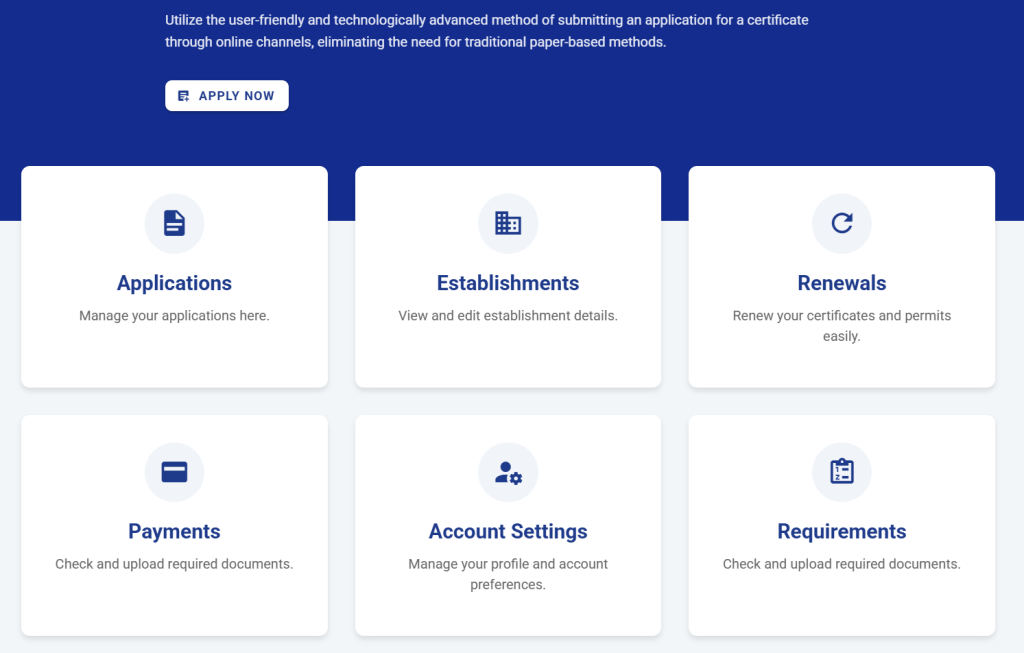
If you prefer to do it online, start by creating an account in the Fire Safety Inspection System and choosing your transaction. Note that your business establishment must be linked to your account first to be able to secure a certificate online.
2. Statement of Account
Once you’ve compiled all the other requirements and submitted them to your BPLO, the assessor’s office will look at your documents and determine your business tax based on your gross sales. The percentage varies depending on your location and the nature of your business.
But to give you an idea, business tax ranges from 1% to 3% of your previous year’s gross sales plus some fixed amount.
Wrapping Up
Staying compliant with BIR and local business renewal requirements may seem complex, but understanding which forms and documents apply to your business makes the process much more manageable. By preparing these requirements ahead of time and keeping accurate records throughout the year, you can avoid penalties, delays, and last-minute stress during renewal season. Use the templates and guides provided in this article to streamline your compliance process and ensure your business remains in good standing year after year.
Related Articles: