Compounding interest is one of the most powerful concepts in finance, yet it is often misunderstood or overlooked. At its core, compounding allows your money to grow not just from the initial amount you invest or save, but also from the interest that amount earns over time. This means your savings or investments can increase at an accelerating rate if left untouched. Understanding compounding is crucial for personal finance, investing, and long-term wealth building.
Think of it like planting a fruit tree: the first year it may produce just a few fruits, but as the tree grows, it produces more fruits every year, and eventually, the fruits grow on the new branches it creates. Compounding works in a similar way, your money grows faster as time goes on.
Compounding Interest Calculator
Estimate how your savings grow with different compounding frequencies
- Calculations assume no withdrawals and interest is reinvested.
- Figures show estimated ending balances for 5 years.
- Results are illustrative and exclude taxes or fees.
Before diving deep into how compounding interest works, here’s a handy calculator you can use for your quick calculations. Of course, understanding the concepts behind it is still important, so continue reading through.
What is Compounding Interest?
Compounding interest occurs when interest is calculated on both the initial principal and the accumulated interest from previous periods. This differs from simple interest, where interest is calculated only on the principal amount.
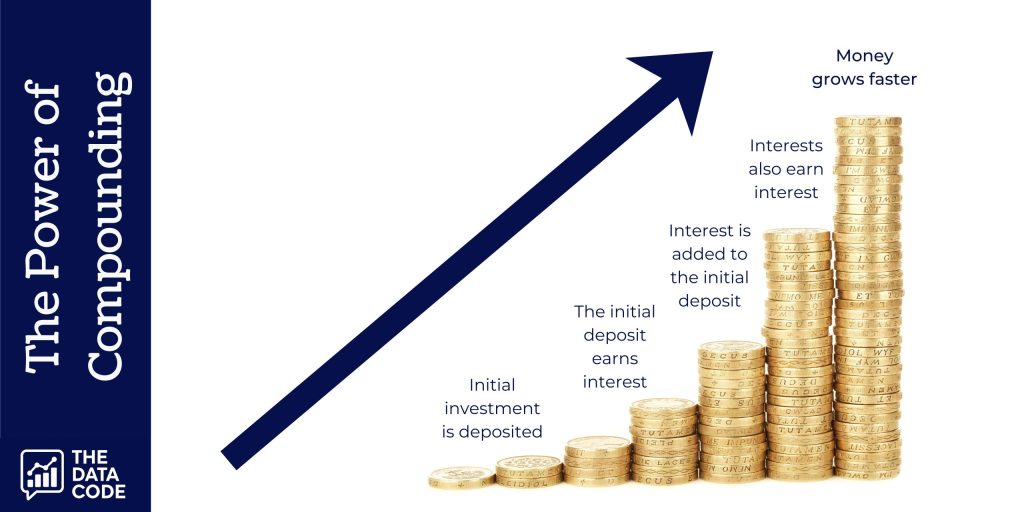
For example, if you deposit $1,000 in a savings account with an annual interest rate of 5%, after one year, you earn $50. In the second year, however, you earn interest on $1,050 instead of just the original $1,000. Over time, this snowball effect can lead to substantial growth.
A real-life analogy is a snowball rolling down a hill: it starts small but grows bigger and faster as it gathers more snow. Similarly, your savings start small, but with compounding, they grow bigger over time.
How Compounding Works
The process of compounding depends on two key factors: the frequency of compounding and the interest rate. The frequency refers to how often the interest is calculated and added to the principal. Common compounding intervals include annually, semiannually, quarterly, monthly, daily, or even continuously. The more frequently interest is compounded, the faster your money grows.
To make it more relatable, imagine putting money into a digital wallet that pays a little extra each month. The first month, the extra is small, but by the twelfth month, you’re earning interest not just on your initial deposit but also on the “extras” from all the previous months.
The Importance of Time
Time is perhaps the most critical factor in compounding. The longer your money remains invested or saved, the greater the effect of compounding.
Consider Sarah and Tom. Sarah starts investing $100 a month at age 25, while Tom waits until he’s 35 to do the same. By the time they’re both 55, Sarah has significantly more money because she had ten extra years of compounding. Even though they contributed the same amount each month, starting early gave Sarah a huge advantage.
This illustrates a simple rule of thumb: the earlier you start, the less stressful saving becomes, and the more your money works for you over time.
Nominal vs. Effective Interest Rates
It’s essential to distinguish between nominal and effective interest rates.
- The nominal rate is the stated annual rate.
- The effective rate accounts for compounding within the year.
For example, if a credit card offers 12% interest compounded monthly, the effective annual rate is actually higher than 12% because interest is being calculated each month on the previously earned interest.
A practical tip for everyday readers: when comparing bank accounts or loans, always check how often interest is compounded, this can make a noticeable difference in your returns or costs.
Continuous Compounding
Compounding is not limited to savings accounts. It applies to investments in stocks, bonds, mutual funds, retirement accounts, and even loans.
For instance, if you reinvest dividends from your stocks instead of spending them, your investment grows faster because each dividend earns its own return. On the flip side, if you leave credit card debt unpaid, compounding can work against you, increasing the total amount owed over time.
Think of it like planting weeds vs. plants in a garden: nurturing your investments allows them to flourish, while ignoring debt lets it grow unchecked.
Compounding in Real Life
In some financial contexts, interest is compounded continuously rather than at discrete intervals. Continuous compounding grows your investment like a constantly inflating balloon. While most banks use daily, monthly, or quarterly compounding, understanding continuous compounding highlights the principle that more frequent interest application accelerates growth.
Everyday Examples of Compounding
To make compounding even more relatable:
- Coffee habit analogy: If you save $5 per day (the cost of your daily coffee) in a savings account with interest, in a year you’ll see the power of compounding turn small daily contributions into a meaningful amount.
- Retirement fund: Even adding a small amount regularly to your retirement account can grow into a substantial nest egg over decades.
- Emergency fund: Starting an emergency fund early, even with small deposits, gives you both security and growth thanks to compounding.
Strategies to Maximize Compounding
To make the most of compounding:
- Start early: Time is your greatest ally.
- Reinvest earnings: Whether dividends, interest, or profits, reinvest to grow faster.
- Contribute consistently: Even small, regular deposits add up over time.
- Opt for frequent compounding: Accounts that calculate interest more often increase growth.
- Avoid unnecessary withdrawals: Each withdrawal slows the compounding process.
Key Takeaway
Compounding interest is often called the “eighth wonder of the world” for a reason. Its power lies in its ability to grow money exponentially over time. By understanding how compounding works, the impact of time, interest rates, and reinvestment, you can make smarter financial decisions and harness the growth potential of your savings and investments.
Whether you are planning for retirement, building an emergency fund, or investing for a major goal, compounding is the financial principle that can turn small, consistent efforts into substantial long-term rewards.
Remember: even small contributions, made consistently and early, can snowball into life-changing amounts over the years.
Related Articles

MariBank: Savings Interest Up To 3.75% (With Calculator)

How to Maximize Maya Savings Interest: Up to 12% p.a. (With Calculator)